
If you’re searching for practical event branding ideas that extend beyond simply enlarging your logo, you’ve come to the right place. In this article, we’ll explore creative ways to incorporate branding into backdrops, LED displays, photo booth overlays, and decor. We’ll also discuss how these choices can enhance brand recognition, improve guest experiences, and increase social media engagement. Plus, we’ll show how PartyBox Oklahoma brings these ideas to life for both corporate events and nonprofit organizations, from concept to execution.
Consider the last memorable event you attended. Perhaps it was a product launch where every element—from the sleek registration desk to the ambient lighting—reinforced the company’s innovative spirit. Or maybe it was a nonprofit gala where the mission statement wasn’t just spoken from the stage but was woven into every visual detail, from the entrance tunnel adorned with beneficiary photos to the centerpieces featuring the organization’s signature colors. These events didn’t happen by accident; they were the result of strategic branding decisions that created an immersive experience.
Why Cohesive Event Branding Matters
The impact of well-executed event branding extends far beyond aesthetics. In today’s competitive landscape, where attendees are constantly bombarded with information and experiences, cohesive branding serves as your event’s compass, guiding every decision and creating lasting impressions.
It Clarifies Your Message: A consistent visual identity helps guests quickly make connections between speakers, activities, and calls to action. When a tech conference uses the same geometric patterns on stage backdrops, directional signage, and presentation templates, attendees subconsciously understand that all elements are part of a unified experience. This visual consistency reduces cognitive load and helps key messages resonate more effectively.
It Enhances Memory: Repeated and coherent visuals serve as memory triggers, making your key messages more memorable long after the event concludes. Research in cognitive psychology shows that visual consistency can improve recall by up to 65%. When attendees see your branded elements weeks later on social media or in follow-up materials, they’re instantly transported back to the event experience.
It Increases Perceived Value: A polished environment conveys to sponsors, donors, attendees, and internal teams that the event is worth their time and investment. A charity auction that invests in professional branding signals to major donors that their contributions are handled with care and professionalism. Similarly, a corporate conference with cohesive branding demonstrates to potential clients that the company pays attention to detail.
It Boosts Shareability: Guests are more likely to capture and share moments in visually appealing, on-brand spaces, leading to organic reach. Instagram-worthy branded photo opportunities can generate hundreds of user-generated content pieces, extending your event’s reach far beyond the physical attendees.
In essence, effective branding transforms a sequence of moments into a compelling narrative. And when your event tells a strong story, the outcomes—such as awareness, engagement, fundraising, and internal alignment—naturally follow.
Establish Your Visual System Before Designing the Space
Before diving into rentals or graphic design, take the time to outline the visual language of your event. This foundational work will save you time, money, and ensure every element works harmoniously together.
Step 1: Define Your Core Elements
Color Palette: Choose a primary color family along with one or two accent colors. Think about how these colors will appear under stage lighting or on LED screens. For example, a vibrant blue might look stunning in natural light but could appear washed out under warm stage lighting. Test your colors in similar lighting conditions when possible.
Typography: Select clear, readable fonts for screens and signage. High-contrast text enhances visibility from a distance. Consider having a primary font for headlines and a complementary font for body text. Sans-serif fonts typically work better for digital displays, while serif fonts can add elegance to printed materials.
Graphic Elements: Incorporate patterns, shapes, or icons that create a cohesive look across all materials. A financial services conference might use clean geometric lines, while a creative agency event could feature organic, flowing shapes.
Image Style: Decide on the vibe—candid vs. posed, abstract vs. literal, high-energy vs. elegant. This decision will guide everything from speaker photography to social media content.
Motion Language: For LED or video, define transitions and pacing so that your graphics feel cohesive. Smooth, slow transitions might suit a luxury brand, while quick, dynamic movements could work better for a tech startup.
Tone: Determine the mood you want to create—bold, playful, refined, mission-driven, or celebratory.
Step 2: Create a Brand Bible
Document these decisions in a comprehensive brand guide that includes color codes (RGB, CMYK, and Pantone), font specifications, logo usage guidelines, and do’s and don’ts. This document becomes your north star throughout the planning process and ensures consistency across all vendors and team members.
Step 3: Consider Your Venue
Your visual system should complement, not compete with, your venue. A rustic barn venue might call for warmer colors and organic textures, while a modern convention center could handle bold, high-contrast elements. Visit your venue at the same time of day as your event to understand natural lighting conditions.
This brand storyboard serves as a guide for every subsequent decision—stage design, wayfinding, photo opportunities, lighting cues, and even the DJ’s playlist. At PartyBox Oklahoma, we incorporate this discovery process to ensure every touchpoint aligns with the story you want to tell.
Actionable Event Branding Ideas
Now, let’s translate your visual system into tangible elements that will make a significant impact at your event.
Branded Backdrops That Tell a Story
Backdrops are more than just decorative elements; they’re powerful storytelling tools that serve multiple functions throughout your event. Here are detailed approaches to maximize their impact:
Strategic Placement and Multi-Purpose Design
Purposeful Step-and-Repeats: Instead of a plain wall, consider using dimensional panels, layered textures, or LED accents to create depth. A step-and-repeat can serve multiple purposes, functioning as a press wall, a VIP backdrop, and the main background for your livestream or photo booth. For a recent corporate merger announcement, PartyBox Oklahoma created a step-and-repeat featuring both company logos that gradually blended into a unified new brand identity across the backdrop’s width.
Modular Scenic Designs with 3D Logos: Use foam or acrylic logos mounted on scenic walls to create tactile branding. Subtle uplighting can make these logos pop without overwhelming the space. Consider creating logos at different scales—a large version for the main stage and smaller versions for breakout areas to maintain consistency while respecting each space’s proportions.
Creating Immersive Experiences
Statement Entry Tunnels: Create a branded walkway for guests to walk through upon arrival. This sets the tone, improves crowd flow, and provides a natural photo opportunity. One successful implementation featured a tunnel with the event hashtag illuminated overhead and branded panels showcasing the event agenda, creating anticipation while serving a functional purpose.
Day-to-Night Transformations: Implement magnetic or slide-in panels that switch graphics between daytime conference visuals and evening gala themes, maximizing your scenic investment. This approach works particularly well for all-day events where the mood needs to shift from professional to celebratory.
Subtle Integration Techniques
- Gobo Projections: Project your logo or patterns onto floors, drapes, or ceilings to subtly brand the space without requiring additional structures. Gobos are particularly effective for creating ambiance in areas where physical backdrops aren’t practical, such as networking spaces or dining areas.
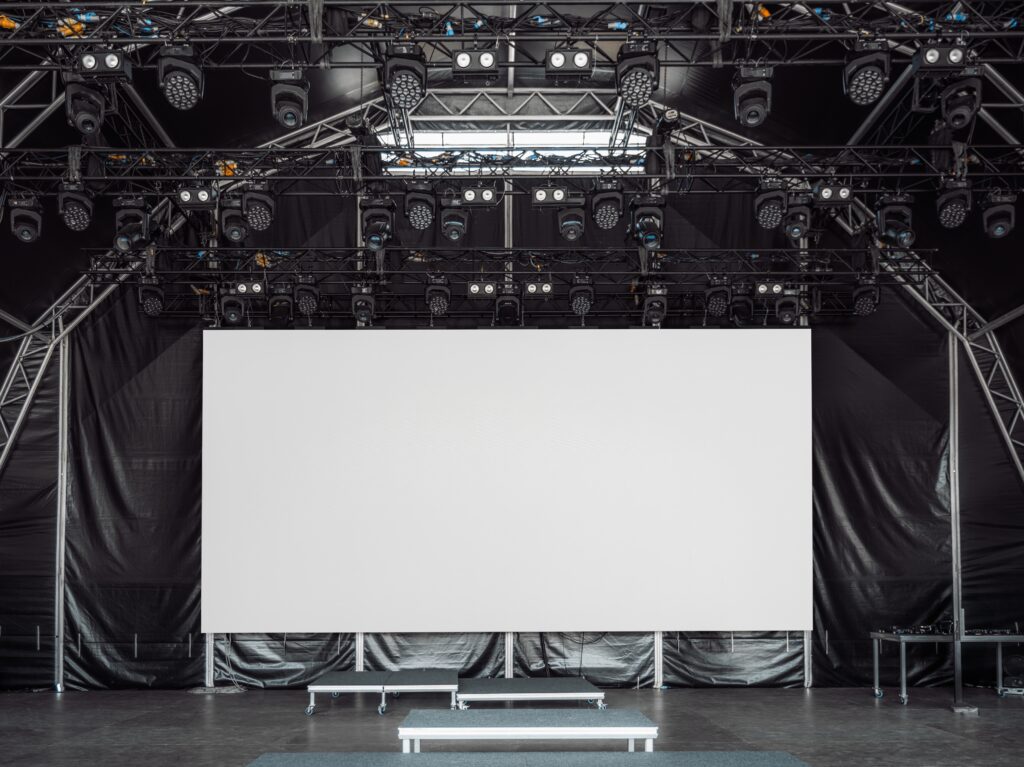
Real-World Example: For a healthcare organization’s annual conference, PartyBox Oklahoma designed a backdrop system that told the story of patient care through layered graphics. The main backdrop featured silhouettes of healthcare workers, with LED backlighting creating depth. Smaller breakout areas used coordinating graphics focusing on specific specialties, maintaining visual consistency while allowing each session to feel unique.
How PartyBox Oklahoma can assist: We design and build custom scenic backdrops tailored to your venue, coordinate on-site placement for optimal sightlines and camera angles, and integrate lighting to ensure your brand stands out both on camera and in person.
LED Displays and Motion Graphics for Dynamic Storytelling
LED technology brings your branding to life through motion, creating dynamic experiences that static graphics simply can’t match. The key is using this technology strategically to enhance, not overwhelm, your message.
Strategic Content Development
Stage Identity: Use a main LED wall featuring your event name with subtly animated backgrounds to provide a consistent anchor during transitions. Consider creating different versions for different program segments—perhaps a more energetic version for opening remarks and a calmer version for educational sessions.
Branded Overlays: Introduce speakers and topics with branded lower-thirds that maintain a professional appearance in photos and videos. These overlays should include essential information like speaker names, titles, and social media handles while maintaining your visual consistency.
Interactive and Responsive Elements
Content Reveals: Build anticipation with motion graphics for product launches, award announcements, or fundraising milestones. A nonprofit gala might feature an animated thermometer showing real-time fundraising progress, while a product launch could use countdown timers with branded animations.
Directional Digital Signage: Use LED totems or screens for real-time updates on schedules, room changes, or sponsor calls to action, all in your visual style. These displays can be updated remotely, allowing for last-minute changes without reprinting materials.
Ambient Enhancement
- Ambient Motion Loops: Soft, textured animations during networking or cocktail hours can maintain your brand’s look without distracting from conversations. These might include subtle particle effects, gentle color transitions, or slowly moving abstract patterns that complement your brand colors.
Technical Considerations
When planning LED displays, consider viewing angles, ambient light conditions, and content refresh rates. Content should be designed specifically for LED displays, with appropriate resolution and color profiles. Text should be large enough to read from the furthest viewing distance, and animations should be smooth to avoid appearing choppy on camera.
PartyBox manages LED specifications, motion design, and show calling to ensure your visuals stay cohesive and your technical execution is flawless.
Photo Booth Overlays, GIFs, and Sharing Stations
Photo opportunities can become powerful user-generated content (UGC) machines when branded effectively. The goal is to make sharing feel natural and rewarding for guests while extending your event’s reach.
Strategic Overlay Design
Custom Overlays: Frame each photo with the event’s branding, date, and hashtag. Keep it simple to let the guests and backdrop shine. The overlay should enhance, not compete with, the subjects. Consider creating multiple overlay options for different types of photos—perhaps one for individual shots and another for group photos.
Animated Branding: Create short branded animations for GIFs and boomerangs. Keep them brief—under two seconds—to ensure posts feel snappy on social media. These animations might include your logo appearing with a subtle effect or branded elements that complement the photo action.
Technology Integration
Green Screen or AR Backgrounds: Transport guests into campaign artwork or mission-aligned scenes without the need for heavy scenic setups. This technology allows for multiple branded backgrounds without physical space constraints and can be updated throughout the event.
QR Code Delivery: Provide instant access to a gallery with a trackable link, making it easy to measure engagement and encourage sharing. Modern photo booth systems can send photos via text, email, or QR code, with branded delivery messages that extend your touchpoints.
Social Amplification
Live Gallery Walls: Display a curated stream of booth photos on LED screens to reinforce FOMO and encourage more participation. This creates a feedback loop where guests see others having fun and want to participate themselves.
Sponsor Tie-Ins: For corporate partners or gala sponsors, tasteful logo placement in overlays or on the booth surface adds value without being overly promotional. This might include small sponsor logos in overlay corners or branded props that guests can use.
Measuring Success
Track metrics like photo session counts, social shares, hashtag usage, and gallery views to measure the photo booth’s impact on your event’s social media reach.
With PartyBox’s interactive photo booths, we design overlays that align with your event’s visual system, manage guest flow, and provide analytics like session counts and digital shares—valuable for post-event reporting.
Branded Decor, Lighting, and Micro-Touchpoints
It’s often the small details that create a fully branded experience. These micro-touchpoints might seem minor individually, but collectively they create an immersive environment that reinforces your brand at every turn.
Environmental Branding
Decor Accents: Incorporate branded bar fronts, table numbers, centerpieces with subtle logos, and floor decals to extend your graphic language throughout the venue. These elements should feel integrated, not like afterthoughts. For example, table numbers might use your brand’s typography and color scheme while serving their functional purpose.
Lighting as Branding: Use color-consistent uplighting and wash lighting to create a unified atmosphere. Adjust lighting palettes to match different program segments (e.g., cooler tones for presentations, warmer tones for receptions). Intelligent lighting systems can transition between different moods throughout the event while maintaining brand color consistency.
Functional Branding
Staged Product or Mission Vignettes: Set up small, styled platforms that showcase a product, a donor story, or an impactful statistic—ideal for photos and conversation starters. These vignettes serve dual purposes: they provide content for social media and create natural networking opportunities.
Lanyards and Badges: Ensure they are legible and comfortable. Include icons to denote roles (attendee, sponsor, staff) to facilitate networking. Consider using your brand colors for different attendee types or incorporating QR codes for contactless networking.
Check-In: Use branded welcome desk wraps, iPad screens, and clear wayfinding to reduce congestion and set a polished tone. The check-in experience sets expectations for the entire event, so invest in making it smooth and on-brand.
Wayfinding and Signage
Develop a comprehensive signage system that includes directional signs, room identification, schedule displays, and sponsor recognition. All signage should use consistent fonts, colors, and graphic elements to maintain visual cohesion throughout the venue.
PartyBox provides lighting, DJ/audio, and decor integration to ensure the mood and visuals are in harmony.
Amplifying Social Media Without Being Pushy
Make it easy for guests to share their experiences organically by creating natural opportunities and incentives for social media engagement.
Strategic Social Integration
Clear Calls to Action: Display your hashtag and social media handle near photo opportunities and on digital signage. Keep it short and easy to spell. Consider creating a unique event hashtag that’s memorable and relevant to your brand or message.
Designed “Wow” Moments: A large, eye-catching prop, neon sign, or LED feature can encourage guests to share their experiences. These moments should feel authentic to your brand and event theme, not forced or gimmicky.
Content Creation Support
Content Prompts: On a slideshow, offer a light-hearted prompt (e.g., “Snap a photo with your team here and tag us to enter a raffle”). Keep it optional and fun, not forced. Prompts might include questions related to your event theme or mission.
Creator-Friendly Lighting: Design well-lit areas for guests to record short videos, enhancing the quality of the content shared on social media. Poor lighting is one of the biggest barriers to social sharing, so invest in creating Instagram-worthy lighting throughout your venue.
Ensuring Accessibility and Inclusivity in Branded Spaces
Effective event branding must be accessible to all attendees. This means considering color contrast for visually impaired guests, ensuring clear sightlines for wheelchair users, and creating inclusive imagery in your branded materials.
Design Considerations
- Use high contrast between text and backgrounds
- Ensure pathways around branded elements are wide enough for mobility devices
- Include diverse representation in any branded photography or graphics
- Consider multiple languages if appropriate for your audience
- Provide alternative formats for any branded informational materials
Corporate vs. Nonprofit: Customizing Brand Execution
Different event types require different branding approaches, though the fundamental principles remain consistent.
Corporate Events: Launches, Conferences, and Internal Gatherings
Corporate events often focus on professional credibility, innovation, and relationship building. Branding for these events should reinforce company values while creating environments conducive to business objectives.
Product Launches
For product launches, branding should create excitement while clearly communicating key features and benefits. Consider creating a reveal moment where branding elements literally unveil the new product, using lighting, motion graphics, or physical reveals.
Example: A software company’s product launch featured a stage backdrop with LED panels that started completely dark, then gradually illuminated to reveal the new product interface, with the company logo appearing as the final element. This created a memorable reveal moment while reinforcing the brand’s tech-forward image.
Corporate Conferences
Conference branding should facilitate learning and networking while reinforcing company expertise. Use consistent branding across presentation templates, signage, and networking areas to create a cohesive educational environment.
Internal Events
Employee events offer opportunities to reinforce company culture and values. Branding for these events can be more playful and personal, incorporating employee photos, company milestones, or internal messaging that wouldn’t be appropriate for external audiences.
Nonprofit Events: Galas, Community Gatherings, and Donor Experiences
Nonprofit event branding should emotionally connect attendees with the organization’s mission while maintaining professionalism that instills donor confidence.
Fundraising Galas
Gala branding should balance elegance with mission focus. Incorporate beneficiary stories, impact statistics, and mission-driven imagery while maintaining the sophisticated atmosphere that major donors expect.
Example: A children’s hospital gala featured branded elements that included subtle child artwork patterns in the lighting design, patient success stories integrated into table centerpieces, and a backdrop that transitioned from medical imagery to hopeful, bright visuals representing healing and growth.
Community Events
Community-focused events allow for more grassroots, authentic branding approaches. Use local imagery, community member testimonials, and interactive elements that encourage participation and engagement.
Donor Stewardship Events
These intimate events should make donors feel valued and connected to the organization’s impact. Branding should be subtle but meaningful, perhaps incorporating personalized elements or exclusive behind-the-scenes content.
Budgeting and Timelines: High-ROI Options and Decision-Making
Effective event branding doesn’t require unlimited budgets, but it does require strategic thinking about where to invest for maximum impact.
High-Impact, Budget-Conscious Options
Lighting as Branding
Colored lighting can transform any space at a relatively low cost. Use your brand colors in uplighting, wash lighting, or accent lighting to create atmosphere without expensive scenic elements.
Digital Signage
LED screens or monitors can display multiple branded messages throughout an event, offering more flexibility than printed materials at a comparable cost.
Strategic Focal Points
Instead of branding every surface, identify 2-3 key areas where attendees will spend the most time or take the most photos, and invest your branding budget there.
Timeline Considerations
8-12 Weeks Before: Finalize visual identity and begin graphic design
6-8 Weeks Before: Order custom printed materials and begin scenic construction
4-6 Weeks Before: Finalize motion graphics and digital content
2-4 Weeks Before: Conduct technical rehearsals and make final adjustments
1 Week Before: Final setup and testing
ROI Measurement
Track metrics like social media engagement, lead generation, brand awareness surveys, and attendee satisfaction scores to measure your branding investment’s effectiveness.
Measuring Impact: What to Track During and After the Event
Successful event branding should be measurable. Establish baseline metrics before your event and track improvements in key areas.
During the Event
- Social media mentions and hashtag usage
- Photo booth session counts and shares
- Attendee engagement with branded elements
- Sponsor satisfaction with brand integration
- Real-time feedback through event apps or surveys
Post-Event Analysis
- Brand recall surveys sent to attendees
- Social media reach and engagement analysis
- Lead quality and conversion rates
- Media coverage and brand mention analysis
- Attendee retention for future events
Long-Term Impact
- Brand awareness studies
- Customer acquisition attributed to the event
- Employee engagement scores (for internal events)
- Donor retention and giving increases (for nonprofits)
Conclusion
Effective event branding is more than decoration—it’s the foundation of a memorable experience. When your visuals, messaging, and environment work together, they create a story guests can instantly connect with and remember long after the event ends. Whether it’s through thoughtfully designed backdrops, dynamic LED displays, engaging photo moments, or subtle decor touches, every element plays a role in shaping how attendees feel and what they take away.
With a clear visual system, strategic planning, and intentional execution, your event becomes not just an occasion, but an experience that elevates your brand, strengthens relationships, and inspires action. And with the right partner—like PartyBox Oklahoma—you can bring that vision to life seamlessly, ensuring every detail reinforces your message and delivers lasting impact.